
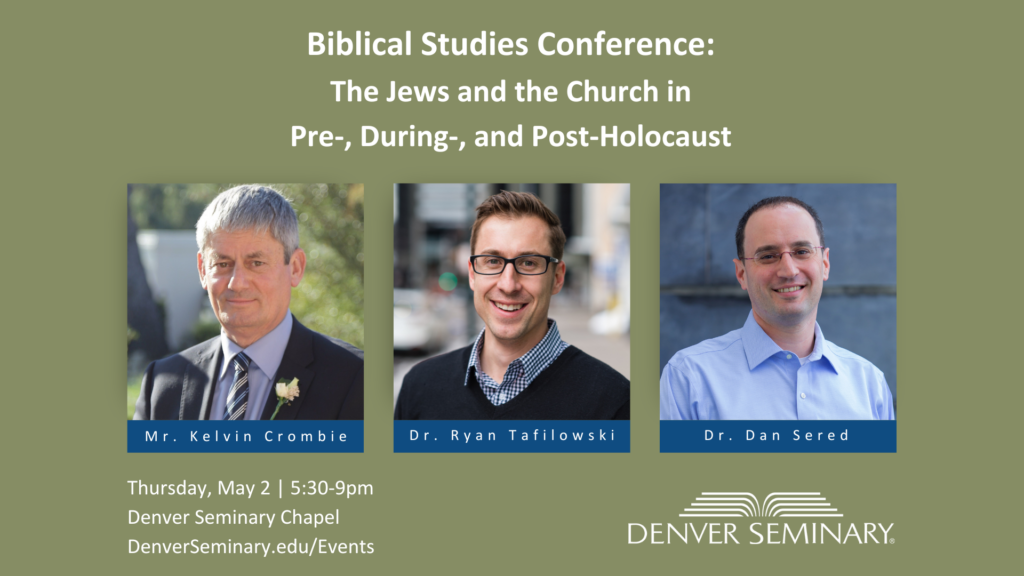
Biblical Studies Conference
The Jews and the Church Pre-, During-, Post-Holocaust
Thursday, May 2, 5:00pm – 9:00pm
Denver Seminary Chapel or Via Zoom
6399 Santa Fe Drive, Littleton
This is a free event.
Online registrants will receive a Zoom link via email prior to the event.
Join us for an evening of fellowship and refreshments, followed by a series of lectures on this important topic:
- 5:00-5:30pm – Fellowship & Refreshments
- 5:30-5:40pm – Introduction
- 5:40-6:30pm – Kelvin Crombie, “Jewish Christians under Nazi Regime – 1933-1945”
- 6:30-6:40pm – break
- 6:40-7:30pm – Dr. Ryan Tafilowski, “A Wound that Will Not Heal: Theological Antisemitism in the German Evangelical Church”
- 7:30-7:40pm – break
- 7:40-8:30pm – Dr. Dan Sered, “The Messianic Movement in Israel post-Holocaust”
- 8:30-9:00pm – Fellowship & Refreshments
Presentation abstracts and speaker bios
“Jewish Christians under Nazi Regime – 1933-1945“
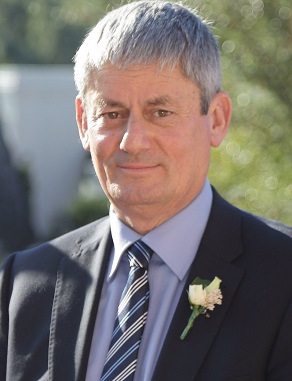
Mr. Kelvin Crombie
While living in Israel for twenty-five years, the Holocaust was always close at hand, especially while working among Holocaust survivors in the early 1980s. In the late 1980s I was involved in setting up the Messianic congregation at Christ Church alongside Benjamin and Reuven Berger, sons of Holocaust survivors. Here was the merging of two matters which are very sensitive to Jewish people – the Holocaust and Messianic Jews. In 2018 Rev David Pileggi of Christ Church asked if I would undertake a research project to determine what happened to the ‘Jewish Christians’ during the Holocaust – the merging of these two sensitive matters. This project has resulted in much research, including five on-site trips, and three major publications on the subject. My presentation looks at the status of ‘Jewish Christians’ during the Holocaust and how Almighty God led me while undertaking this difficult research project.
About the speaker
Born in the Australian bush with little Christian heritage, Kelvin developed an interest in Israel, the Jewish people and the Holocaust at a young age – while reading why Australian soldiers including family members served in the Middle East during both World Wars. This interest increased when an Israeli family moved to a nearby farm. In 1979, while searching for the meaning to life, he went to Israel. Then at the Garden Tomb on Easter Sunday 1981 Kelvin heard about Jesus being Jewish, and he became a follower of Jesus. In 1986 Kelvin became the guide/historian at Christ Church in the Old City, operated by CMJ (Church’s Ministry among Jewish People). Thereafter he authored numerous books including A Jewish Bishop in Jerusalem: The Life Story of Michael Solomon Alexander (2006), El Alamein: Halting an Impending Holocaust in the Middle East (2012), Bazyli and Anna Jocz: Jewish Christian Victims of the Holocaust (2021), Jewish Christians in the Netherlands during the Holocaust (2022), and Seven Phases of the Holocaust (2023). Kelvin married Lexie in 1984 and their four daughters were born in Israel. They moved to Australia in 2009.
“A Wound that Will Not Heal: Theological Antisemitism in the German Evangelical Church“
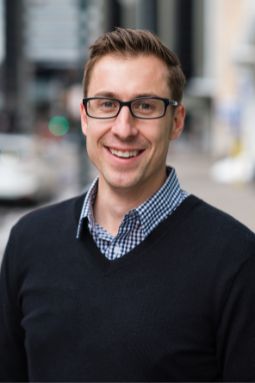
Dr. Ryan Tafilowski
On the eve of Adolf Hitler’s rise to power, the prominent Lutheran theologian Paul Althaus (1888-1966) objectified the Jews as an ‘open wound’ on the bodies of their European ‘host-peoples,’ but he refused to accept the radical racial ideology of National Socialism. Yet when the party’s measures against the Jews escalated, Althaus did not object. This essay argues that Althaus’s ambivalence toward the so-called “Jewish Question” is reflective of a widespread theological antisemitism in the German Evangelical Church of the 1930s and 40s. Working in an era remembered most for its heroes and villains, this paper seeks to problematize the common complicity/resistance dichotomy and examines Althaus as a case study in the ambivalence of Protestant attitudes toward Jews, showing that even “moderate” figures were capable of producing noxious permutations of the theological antisemitism that has plagued the Christian imagination from its earliest days.
About the speaker
Currently serving as Assistant Professor of Theology and Chair of the Theology Department at Denver Seminary, Ryan holds a PhD in systematic theology, an MA in historical theology from the University of Edinburgh, and a bachelor’s degree in biblical studies from Colorado Christian University. Prior to joining the faculty at Denver Seminary, Ryan served as adjunct professor of theology at Colorado Christian University, and postgraduate instructor in theology and ecclesiastical history at the University of Edinburgh. Ryan is currently the lead pastor at Foothills Fellowship Church in Denver and Theologian-in-Residence at the Denver Institute for Faith and Work. His publications include ‘Dark, Depressing Riddle’: Germans, Jews, and the Meaning of theVolkin the Theology of Paul Althaus (2019).
“The Messianic Movement in Israel post-Holocaust”
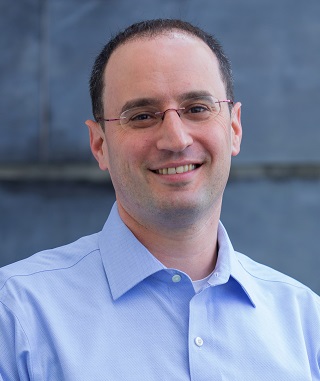
Dr. Dan Sered
After World War II, Jewish Evangelism underwent profound transformations catalyzed by historical events such as the Holocaust, the rebirth of Israel as a nation, the Jesus Movement, the Lausanne Movement, and the fall of the Soviet bloc leading to immigration from the Commonwealth of Independent States. Despite challenges both within the church and from the Jewish communities themselves, God has used tragedy for His glory and ultimately throughout His plan in reaching the Jewish people with the gospel. Renewed confidence in Jewish identity within a Jewish state has created more evangelistic opportunities, albeit alongside enduring opposition within some of the most religious communities. Jewish evangelism in Israel has experienced notable growth in the last eighty years as organizations such as Chosen People Ministries, Jews for Jesus, Tikkun Global, and One for Israel expanded their presence and incorporated evangelistic strategies that encompassed both traditional methods as well as more modern approaches. According to research done by the Caspari Center in 2020, the number of Jewish believers globally is 3.1 times larger than it was in 1999. Throughout all of this, common theological denominators, such as eschatological restorationism, have been extremely unifying leading to an uprise in the Messianic movement. Overall, these efforts have reflected a commitment to meeting people where they are, understanding their unique backgrounds and needs, and building genuine relationships as a foundation for sharing the message of faith.
About the speaker
Born in Israel to a secular Jewish family, Dr. Dan Sered relocated to the US in his teens. While at Stony Brook University in NY, he met Dinah, a Jewish believer who led him to Yeshua, his Jewish Messiah. In 1999, Dan and Dinah were married, began serving as missionaries with Jews for Jesus, and moved to Israel. In 2006, Dan became the Israel Director of Jews for Jesus (JFJ) and in 2019, he was appointed Chief Operating Officer over the branches in Europe, South Africa, Israel, and Australia. Dan received his MA in Ministry and Leadership from Western Seminary and his Doctor of Ministry in Leadership from Dallas Theological Seminary. He is currently serving as the President of the Lausanne Consultation on Jewish Evangelism and serves as Co-Catalyst for Jewish Evangelism in the Lausanne Movement. Dan also serves as adjunct professor at Israel College of the Bible and has served as assistant-pastor at All Nations Church in Petah Tikvah, Israel for 17 years. He & Dinah have 3 children: Yael, Eithan, and Yoav.